The problem with traditional visual management
Picture a project lasting 24 months. During that period, thousands of events take place: team movement, truck arrivals and departures, equipment operation, material deliveries, concrete pours, structural assemblies, installations, finishing work.
Even in well-managed projects, it is nearly impossible to track everything in person. In practice, many managers rely on photos sent via email, weekly reports, progress meetings and periodic site visits. The problem is that these represent only small snapshots of reality. Between one visit and the next, dozens of situations can occur without any structured record.
This creates difficulties in validating productivity, proving physical progress, identifying bottlenecks, detecting delays early and communicating results to clients and investors. This is precisely where Visual Intelligence begins to generate value.
What is Visual Intelligence?
Visual Intelligence is the ability to use images as a source of operational data. Instead of serving only for human observation, images are automatically analyzed by algorithms capable of identifying patterns, objects, movements and changes over time.
In construction, this means a camera is no longer just monitoring equipment — it becomes a permanent visual sensor for the project. From this sensor, it is possible to extract information such as the number of people on site, machine movement, presence of trucks and elevated platforms, physical progress of the project, areas of highest activity, temporal comparison between periods and automatic report generation.
The result is a new layer of information that complements traditional engineering indicators.
How AI analyzes a construction site
Modern systems use computer vision models trained to recognize specific elements within the monitored environment. Each captured image is processed automatically. The system identifies relevant objects and records their occurrence.
People
The algorithm detects workers present in the monitored area. This allows creating indicators related to site occupancy and activity intensity.
Trucks
Logistics movement is recorded visually. This makes it possible to understand periods of higher operational flow.
Excavators and equipment
Heavy equipment can be identified automatically, helping to understand the dynamics of work fronts. Over weeks and months, this data creates an extremely rich operational history.
Elevated Platforms
Aerial work equipment is also detected by the system. This allows monitoring the usage of elevated platforms throughout the project, identifying operation periods and cross-referencing this data with the schedule of activities that require this type of equipment.
"Visual Intelligence transforms passive images into active data — what was once just a visual record becomes a continuous operational indicator of the construction site."
The power of heat maps
One of the most interesting applications of Visual Intelligence is heat map generation. The concept is simple: every time a person or piece of equipment is detected in a certain region of the image, that information is recorded. Over time, the system creates a visual representation showing where the highest concentration of activity occurred.
The result allows answering questions like: where do teams spend the most time? Are there underutilized areas? Are there regions with excessive movement? Is the operational flow consistent with the plan? Without this type of analysis, many of these patterns would go unnoticed.
Temporal comparison: seeing project evolution
Traditionally, comparing the progress of a project requires finding old photographs and trying to align them manually. This process is time-consuming and often imprecise.
With modern platforms, managers can compare specific dates in seconds. This allows assessing physical progress, identifying structural changes, verifying schedule compliance and producing documentary evidence. In long-duration projects, this feature becomes extremely valuable.
Timelapse: far beyond marketing
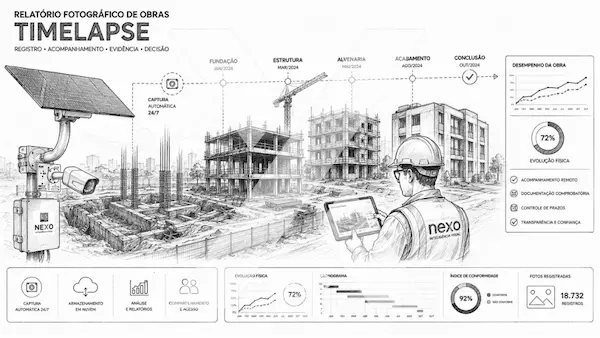
Many people associate timelapse only with promotional videos. In reality, its operational value is much greater. By condensing months of work into a few minutes, timelapse allows reviewing completed stages, documenting processes, recording important milestones, creating a permanent project history and facilitating future audits.
Furthermore, when generated automatically, it eliminates the need for manual editing and image organization. Timelapse ceases to be just a communication piece and becomes a management tool.
Remote monitoring: management without unnecessary travel
One of the biggest inefficiencies in geographically distributed projects is the constant need for travel. Directors, coordinators and investors often need to travel just to check on project progress.
With continuous remote monitoring, much of this travel can be replaced by quick consultations from anywhere. The benefits include time savings, reduced travel costs, faster decisions, more frequent monitoring and greater operational visibility. This becomes even more important for companies managing multiple projects simultaneously.
Transparency for clients and investors
Communicating progress is a recurring challenge in construction. Technical reports often fail to clearly convey project evolution. Chronologically organized images solve this problem immediately.
When combined with Visual Intelligence, they enable much more compelling presentations. Investors can see the real evolution of the project, understand executive milestones, validate schedules and track deliveries. Transparency increases significantly.
Visual evidence for risk management
Contractual conflicts can arise for various reasons: questions about deadlines, disagreements over execution, damage caused by third parties, discussions related to productivity. Having a continuous visual history considerably reduces these uncertainties.
Instead of relying only on reports or documents, the company gains objective visual evidence. This history often becomes one of the project's most valuable assets.
The impact on productivity
When managers have quick access to the right information, decision-making improves. The consequence is direct: shorter response times, less waste, greater predictability and better resource utilization.
Although the camera remains the same, the value generated by the information extracted from it is exponentially higher. It is precisely this paradigm shift that differentiates traditional monitoring from Visual Intelligence.
The future: data-driven construction sites
In the coming years, the amount of information extracted from images will increase dramatically. Artificial intelligence models are evolving rapidly. Soon we will see systems capable of detecting specific construction stages, identifying planning deviations, recognizing additional equipment, estimating physical progress automatically and generating proactive alerts.
The camera will cease to be just an observation instrument. It will become a strategic data source for management. Companies that start this transformation now will have a significant competitive advantage.
Conclusion
Construction is undergoing a transformation similar to what other sectors experienced with digitalization. Where decisions once depended on manual reports and in-person observation, it is now possible to use artificial intelligence to continuously interpret what happens on a construction site.
Visual Intelligence represents this new stage. It combines remote monitoring, computer vision, automated timelapses, heat maps and temporal analysis to provide information that was previously invisible.
More than just monitoring projects, it is about understanding the operational behavior of the project and transforming images into knowledge. In an increasingly competitive market, companies that use visual data to make decisions tend to be more efficient, more transparent and better prepared for the future challenges of construction.