What is Visual Intelligence on construction sites?
Visual Intelligence is the application of computer vision models to extract useful information from images captured by cameras in an environment. In the context of construction, this means transforming hours of video into structured data about human and machine activity on site.
Unlike a security camera — which requires a human operator monitoring a screen — a Visual Intelligence system operates autonomously. It detects, classifies and records events continuously, 24 hours a day, 7 days a week, without human intervention.
How AI detects people, trucks, excavators and elevated platforms
The NEXO platform uses object detection models trained specifically for the construction site environment. Unlike generic models, training is conducted with real site images — which significantly increases accuracy under typical conditions: dust, lighting variations, long distances and partial occlusions.
Four main categories are detected and classified in real time:
- People: workers and visitors present in the monitored area
- Trucks: cargo vehicles in motion or parked
- Excavators: heavy earthmoving and excavation machinery
- Elevated Platforms: aerial work equipment
Each detection is recorded with a timestamp, position in the image and model confidence level. This data feeds the weekly reports and spatial heat maps.
Heat map: seeing invisible patterns
One of the most powerful features of Visual Intelligence is the spatial heat map. From the coordinates of each detection over time, the system generates a visualization indicating the areas of highest activity concentration on the site.
In practice, this allows identifying bottleneck points (where there is excessive movement), underutilized areas and circulation flows that can be optimized. It is a view that no manager could ever obtain through in-person observation alone.
"A weekly heat map can reveal in seconds what would take weeks of in-person observation to notice."
Automatic weekly Visual Intelligence reports
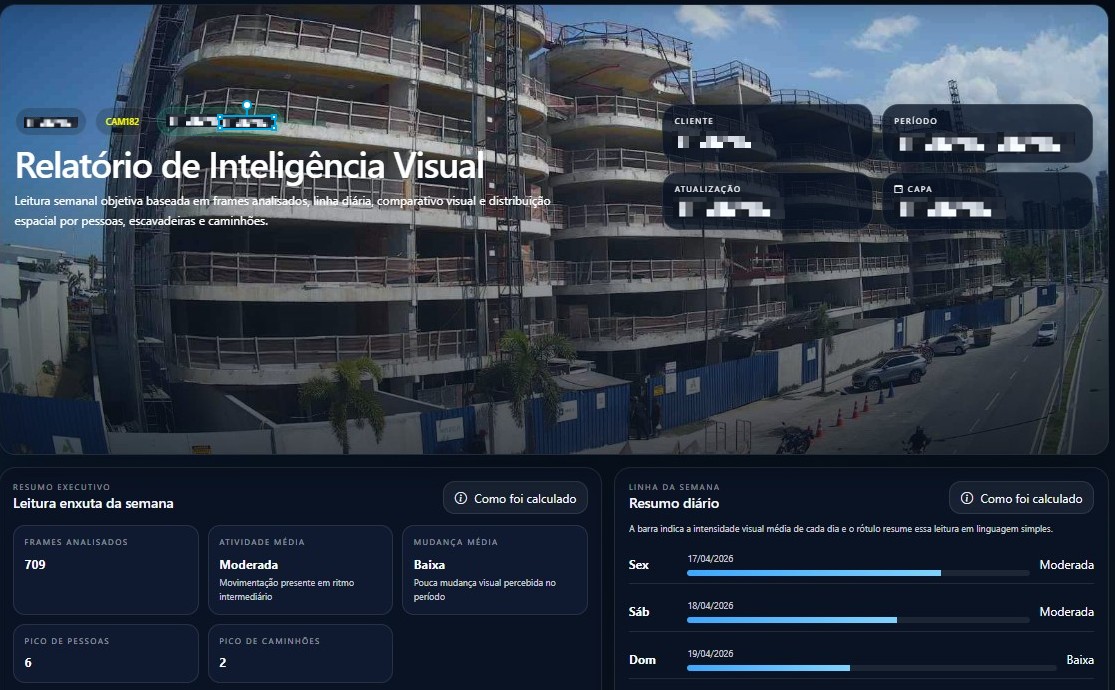
Weekly, the NEXO platform automatically generates a Visual Intelligence Report with the key metrics for the period. It includes:
- Executive summary with AI-based narrative interpretation
- Heat map for the period (filtered by object type)
- Comparison with the previous week
- Images automatically highlighted by the system
The report is sent by email/email to registered contacts on the platform. Managers and stakeholders receive a clear view of what happened on site without having to analyze hours of video.
What changes in practice for site managers
The main change is the transition from a reactive to a proactive management model. With structured data on site activity, the manager gains the ability to:
- Identify productivity drops before they become schedule delays
- Validate whether teams are present and active during contracted hours
- Detect improper use of equipment outside working hours
- Generate visual evidence for client and investor reports
- Support team redistribution decisions based on real data
Visual Intelligence does not replace the manager — it amplifies their analytical capacity, allowing decisions to be made based on objective evidence rather than subjective perceptions.