AI's moment in construction
The construction industry moves hundreds of billions of dollars each year, yet has historically struggled with tight margins, wasted resources and information asymmetry between those on site and those making decisions.
In this landscape, AI has found fertile ground. Unlike sectors like finance or retail — which were already digitized before AI arrived — construction is leapfrogging stages. Many projects are going straight from manual recording to automated computer vision analysis, skipping intermediate stages of digital maturity.
What makes 2026 a landmark year is not the emergence of a revolutionary technology, but the maturity of applications that already exist and now operate at scale. Computer vision models have matured, connectivity providers have expanded, and hardware costs have made monitoring viable for projects of all sizes.
1. Visual detection of people, machinery and equipment
The most widespread AI application on construction sites in 2026 is automatic object detection. Computer vision systems can identify and classify elements on site in real time with high accuracy.
The four consolidated categories in the market are:
- People: workers and visitors in the monitored area
- Trucks: cargo vehicles in motion or parked
- Excavators: heavy earthmoving and excavation machinery
- Elevated Platforms: aerial work equipment
The differentiator in 2026 is model reliability. Unlike generic solutions, models trained specifically on real images from Brazilian construction sites achieve far greater accuracy under challenging conditions — dust, lighting variation, long distances and partial occlusions.
Each detection is recorded with a timestamp, position in the frame and confidence level. This transforms a video stream into structured data, ready to feed dashboards, reports and automatic alerts.
What is it used for in practice?
On the front line, this data lets managers know how many people were on site at each hour, whether truck flow is within expectations, whether elevated platforms are being used as planned — all without needing to be on site.
2. Activity heat maps
If detection answers "what" is happening, the heat map answers "where". By aggregating thousands of detections over time, the system generates a visual representation revealing the regions of highest activity concentration on site.
In 2026, this feature has gone from a differentiator to a mandatory item in construction monitoring platforms. Heat maps can be filtered by object type, enabling segmented analysis:
- Where do teams circulate most frequently?
- What are the truck routes within the site?
- In which areas do excavators operate most?
- Are elevated platforms being used in the planned regions?
The practical value lies in identifying circulation bottlenecks, underutilized areas and safety perimeter violations before they become problems.
"A weekly heat map filtered by people can reveal in seconds that 70% of workers are concentrated in 30% of the area — a clear sign that workflow needs to be reorganized."
3. Automatic visual intelligence reports
One of the applications delivering the most immediate return is automatic report generation. Instead of teams spending hours compiling photos, writing summaries and formatting documents, AI handles it all automatically.
The weekly Visual Intelligence report consolidated in 2026 includes:
- Narrative executive summary: AI interprets the period and describes the most relevant events in natural language
- Period heat map: spatial distribution of activity, filtered by detection type
- Week-on-week comparison: side-by-side visual evolution
- Auto-highlighted images: the system selects the most representative frames
This report is automatically sent via email and email to registered contacts. Managers, clients and investors receive a clear view of what happened on site without having to analyze hours of video.
4. 24/7 monitoring with intelligent alerts
Where continuous monitoring once meant a person watching CCTV screens, in 2026 it is done by algorithms that work 24 hours a day, 7 days a week — no fatigue, no distraction, no breaks.
Current systems can generate automatic alerts based on events such as:
- People present during non-business hours (possible theft or unauthorized access)
- Equipment movement outside scheduled hours
- Prolonged absence of activity in areas that should be operational
- Abnormal concentration of people or machinery in one region
For construction companies managing multiple projects, this type of remote monitoring drastically reduces the need for travel and enables a central team to track dozens of projects simultaneously.
5. Timelapses with an intelligence layer
Traditional timelapse — the kind that speeds up time to show project evolution — gained an additional intelligence layer in 2026. Videos can now be generated with detection overlays, heat maps and filters by object category.
This means a manager can generate, in seconds, a timelapse showing exclusively the movement of people over the last 30 days, or a video highlighting only the operation of excavators and elevated platforms throughout the period.
The result is an analysis tool that combines the synthesis power of timelapse with the precision of AI data.
6. Automated temporal comparison
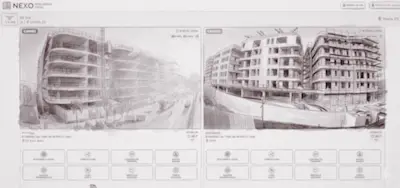
Comparing the physical progress of a project has always been a manual and imprecise process. In 2026, platforms allow selecting two dates and instantly obtaining a side-by-side visual comparison with the same framing.
Practical applications include:
- Validation of completed stages versus schedule
- Documentary evidence for measurements and billing
- Executive milestone records for clients and investors
- Support for technical and contractual audits
What changes in project management
The main transformation AI has brought to construction in 2026 is not in the technology itself, but in the management model. Information that was once subjective ("I thought the team was productive") becomes objective ("detection shows 12 people were in the assembly area between 8am and 10am").
In practice, this means managers shift from a reactive model — discovering problems only when they are too big to ignore — to a proactive model, where deviations are identified early and decisions are made based on evidence.
For companies managing multiple projects, the scale gain is even greater. A monitoring center can track dozens of projects with the same team that previously managed two or three.
What to expect in the coming years
The applications of 2026 are just the beginning. AI in construction is expected to advance in three main directions in the coming years:
- Predictive models: instead of only detecting what is happening, systems will begin to predict risks, delays and deviations before they occur
- BIM integration: visual detection will be automatically compared with the project's 4D model, generating alerts for deviations between planned and executed
- Full report automation: reports will become increasingly analytical, with automatic recommendations for corrective actions
Companies that have already adopted these applications in 2026 are building not only more efficient projects, but also a competitive advantage that will become increasingly difficult for those left behind to catch up with.
Conclusion
Artificial intelligence in construction has moved from promise to working tool. In 2026, the practical applications are already tangible: visual detection of people and equipment, heat maps, automatic reports, 24/7 monitoring with alerts, intelligent timelapses and temporal comparison.
The common denominator across all these applications is the transformation of images into data — and data into decisions.
For managers who have not yet adopted these technologies, the question is no longer "why invest in AI?" but "how much longer can I afford to operate without it?"