What Is Timelapse and How Does This Technology Work
The timelapse concept and how it differs from traditional video
Traditional video captures between 24 and 60 frames per second — fast enough to reproduce human movement fluidly and naturally. Timelapse inverts that logic: instead of dozens of images per second, the system records one image at each predefined interval — seconds, minutes or hours — and plays back that image sequence at standard video speed.
The result is time compression: what took hours passes in seconds, what took months passes in minutes. This characteristic makes timelapse perfectly suited to documenting slow, gradual processes — such as the growth of structures, the movement of heavy equipment or the complete transformation of a site — while actions that happen quickly simply disappear between one frame and the next.
If you have ever watched a building being erected from scratch to completion in three minutes, you have already experienced a timelapse. The name combines time and lapse (an interval, a passage). That is exactly what the technique does — it compresses the passage of time into something the human eye can absorb quickly and powerfully.
How sequential images create the acceleration of time
The perception of acceleration is a purely mathematical effect. If the camera captures one image every 5 minutes and the video is played back at 24 fps, each second of video represents 2 hours of real time. A 12-month construction project documented daily over 10 hours — with one capture every 5 minutes — generates approximately 43,000 images, condensed into a roughly 30-minute video at normal speed, which can be compressed down to 2 to 3 minutes by adjusting the playback frame rate.
The quality of this image sequence depends on one critical factor: uniformity. Position changes, sudden exposure swings or gaps in continuous visual recording show up immediately in the final video as jumps, tremors or darkening. This is why frame rate control and the consistency of the capture system matter as much as the camera's resolution.
Core technical elements of a timelapse system
A professional interval-capture system consists of:
- Camera: high-resolution sensor with control over exposure, ISO and focus — manual or remote.
- Intervalometer: device or software that triggers the camera at precise, regular intervals, ensuring consistent cadence.
- Mounting structure: rigid support that keeps the camera in exactly the same position for the entire duration of the project.
- Power system: stable supply with a UPS (uninterruptible power supply) to protect against the surges and outages common on construction sites.
- Local storage: card or disk for immediate backup of images before transmission.
- Connectivity: 4G/5G or wired data link for image transmission and remote access to the system.
- Monitoring software: system that continuously checks camera health and sends alerts at any sign of anomaly.
The evolution of timelapse in visual documentation
The technique has existed since the early days of cinema — the first examples date from the late nineteenth century. What has changed radically over the past two decades is the infrastructure that allows it to be executed autonomously and reliably for months or years at a stretch, without constant manual intervention.
Modern timelapse has evolved from a niche artistic technique into a corporate visual documentation tool with direct applications in engineering, civil construction, environmental monitoring and asset management. Integration with cloud storage, remote connectivity and, more recently, computer vision models and artificial intelligence has enormously expanded the scope — and the strategic value — of this technology.
How a Professional Timelapse Is Made
Equipment used in professional projects
The difference between an amateur and a professional timelapse begins with the equipment. For short-duration projects (a few hours or a single day), a conventional DSLR camera with a dedicated intervalometer works well. For long-duration projects on construction sites — where the equipment will be exposed for months — the requirements are entirely different:
- Dedicated timelapse camera or industrial IP camera with IP67 protection against dust and water
- Enclosure with thermal management to operate in temperatures ranging from −10 °C to over 60 °C inside metal housings exposed to direct sunlight
- Fixed-focus lens to eliminate the risk of focus loss from vibration or temperature change
- Internal UPS to protect against power outages and surges
- Integrated 4G/5G modem for data transmission and remote access without site visits
- Optional solar panel for locations without mains power
Configuring capture intervals
The capture interval is the variable that most influences the volume of data generated and the apparent speed of the final video. The choice depends on two factors: the speed of the process being documented and the volume of data the system can store and transmit.
For civil construction projects, the most common interval is between 3 and 10 minutes. An intervalometer set to 5 minutes over a 10-hour working day produces 120 images. Over 365 days, that is more than 43,000 images — which at 24 fps results in a video of approximately 30 minutes, compressible to 2 to 3 minutes by adjusting the playback rate.
Shorter intervals (1 to 2 minutes) capture more movement detail but increase data volume and cloud storage costs. Longer intervals (15 to 30 minutes) reduce volume but miss short-duration events that may be operationally significant.
Storage and processing of images
The volume of data generated by a professional project surprises those unfamiliar with the numbers. A full-resolution camera capturing every 5 minutes over a year can generate between 300 and 500 GB per camera. Projects with multiple cameras or 4K resolution multiply that figure significantly.
Cloud storage is essential for archive security, but it does not replace local backup: on sites with unstable connectivity, the camera must continue capturing and storing locally even without active transmission. The right solution combines temporary local storage with automatic, continuous synchronisation to at least two independent cloud servers.
Editing and rendering the final video
Post-production involves organising images in sequence, colour and exposure correction, applying deflicker (to eliminate brightness variations between consecutive frames), setting the final frame rate and rendering the video file.
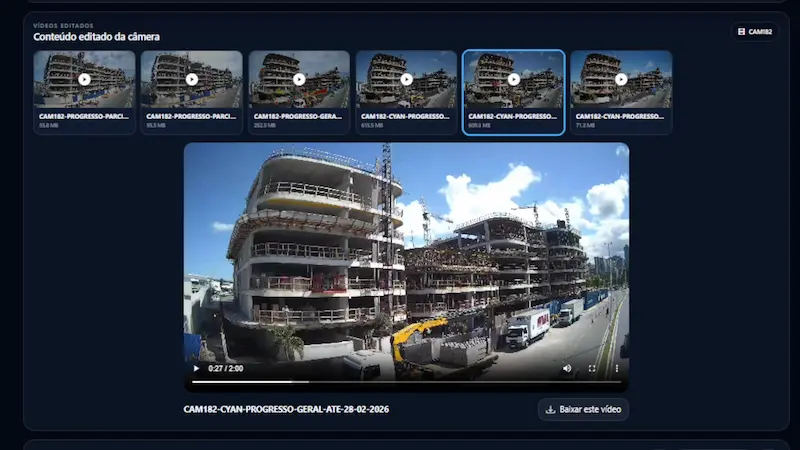
Tools such as Adobe Lightroom (for batch correction), LRTimelapse (for deflicker and exposure ramping) and Adobe Premiere Pro or DaVinci Resolve (for final editing and rendering) are the most widely used in professional productions. On dedicated platforms such as NEXO, this entire post-production process is automated: the daily timelapse is generated and published automatically every morning — with no action required from the site team.
Main Types of Timelapse
Construction and civil engineering timelapse
This is the most relevant application in the corporate and engineering context. Construction timelapse documents the entire evolution of a project from an empty plot to the completed structure, covering every stage: foundations, structure, masonry, installations, finishes. It is simultaneously a historical record, a management tool and a communication asset.
The defining characteristic of this type of timelapse is duration: civil construction projects rarely last less than six months, and larger works can extend to two, three or more years. This places construction documentation firmly in the long-term category — the most demanding from the standpoints of equipment, infrastructure and reliability — where professional-grade interval photography is irreplaceable.
Urban and architectural timelapse
Used to record the transformation of urban areas, the evolution of neighbourhoods, the installation of public infrastructure (flyovers, bridges, metro lines, parks) or the revitalisation of spaces. It has strong visual appeal and is widely used in the institutional communications of local governments, concessionaires and property developers.
Architectural timelapse also documents landmark projects — corporate headquarters, museums, stadiums — as both a historical record and a long-term marketing asset that continues generating value well after the project is completed.
Environmental and meteorological timelapse
Applied to the visual monitoring of natural phenomena: cloud movement, tidal variation, coastal erosion, vegetation growth, river flooding. Widely used in scientific research, environmental licensing projects and monitoring of risk areas.
On construction sites located in environmentally sensitive zones, environmental timelapse can be integrated with construction monitoring to document both the advance of the build and the impact on the surrounding natural environment — generating evidence for environmental compliance reports.
Hyperlapse and motion timelapse
Hyperlapse is a variation in which the camera moves between frames — following a predefined path while time is compressed. The result combines the temporal acceleration of timelapse with the camera movement of conventional cinema.
Technically more complex to execute (requiring motion control equipment and specialised post-production), hyperlapse is used primarily for high visual-impact productions: institutional videos, title sequences, major project presentations or marketing materials that need to stand out visually.
Timelapse Applications in Engineering and Construction
Remote construction site monitoring
Remote monitoring via timelapse is one of the highest-value practical applications for engineering managers. With internet-connected cameras strategically positioned on site, it is possible to track construction progress in real time from any device — without travelling to the location.
Beyond continuous visual recording, integrated systems allow managers to check live images, review history for any period and visually compare progress between different dates. For managers responsible for multiple projects simultaneously, this remote monitoring capability is transformative in terms of operational efficiency.
Visual reporting for clients and investors
Physical progress on a construction project is difficult to communicate through text or spreadsheets. Completion percentages do not convey the real scale of what is being built. Timelapse solves this problem: a two-minute video showing a project's evolution from the start communicates more than any written report — and is interpreted the same way by an experienced engineer and by an investor with no technical background.
For property developers, contractors and engineering firms, automated timelapse has become a tool of project transparency: clients and investors receive periodic visual updates without the site team having to prepare manual presentations.
Productivity and schedule management
Reviewing the day's timelapse reveals patterns that escape everyday perception: machine idle periods, bottlenecks in material flow, poorly positioned teams, overlapping work fronts creating interference. This kind of execution control would be impossible without continuous visual recording.
With visual analysis integrated into the physical schedule, managers can identify deviations before they become significant delays — a direct application of visual intelligence to construction management that reduces response times to operational problems.
Historical record and execution audit
The image archive generated over the life of a project has value beyond the project itself. In contractual disputes, deadline litigation or investigations into responsibility for construction defects, a complete chronological record is high-value technical evidence — objective, dated and irrefutable.
Retroactive execution auditing — verifying what was done, when and how — becomes possible when an intact visual archive exists. This benefit is especially relevant on projects with multiple subcontractors, where establishing responsibility for problems detected after completion can be legally complex.
Benefits of Timelapse for Companies and Projects
Improved visual communication across projects
A project's operational efficiency depends significantly on the quality of communication between all parties: client, financier, design team, field team and suppliers. Timelapse creates a common visual language that eliminates ambiguity and accelerates decision-making. A video is interpreted the same way by a seasoned engineer and by a board member with no technical background — reducing approval cycles and aligning expectations far more efficiently than written reports.
Fewer site visits and in-person inspections
Every technical visit to a construction site has a direct cost (transport, accommodation, professional hours) and an indirect cost (time out of the office, productivity impact). With remote monitoring via timelapse, many in-person inspections can be replaced or prepared with much greater precision, eliminating unnecessary travel and increasing the efficiency of the visits that do need to happen.
For companies with projects across multiple cities or regions, this reduction in site visits represents a significant decrease in operational costs over the project lifecycle.
Stronger marketing and corporate branding
A well-documented project becomes lasting content. A timelapse of a major development is marketing material that continues generating value long after the building is complete: contractors, developers and engineering firms that document their projects professionally build a differentiated visual portfolio and develop corporate communications with a depth and credibility difficult to achieve through other formats.
Timelapse videos of completed projects are widely used in sales presentations, corporate websites, social media and business development materials — at near-zero marginal cost, since the images were captured automatically throughout the entire project.
Visual proof and technical documentation
Beyond communication value, timelapse serves as formal technical documentation: it records the construction sequence, the condition of structures at each stage, events that occurred on site and the state of the terrain before, during and after the work. This documentation has direct value in environmental licensing processes, construction insurance, expert reports and quality audits — where dated visual evidence carries significant probative weight.
The Difference Between Traditional Timelapse and Visual Intelligence Timelapse
Integration with dashboards and online monitoring
Traditional timelapse produces a deliverable: the video. Visual intelligence timelapse goes further: the captured images feed a real-time operational dashboard where managers verify live camera feeds, review images for any date and time, compare progress between periods and track indicators derived from automatic image analysis.
This integration transforms timelapse from a one-off visual deliverable into a continuous monitoring system — with data, indicators and a navigable archive, not just videos.
AI-powered automatic image analysis
Computer vision models applied to the timelapse image stream automatically detect and quantify elements present on site: people, vehicles, machinery, equipment. This visual analytics layer transforms passive images into active data about site state and activity at every moment of the day.
Automated analysis eliminates the need for manual review of hours of footage to extract operational information — and enables systematic, scalable generation of productivity, presence and equipment utilisation indicators.
Alerts, heat maps and operational detection
Visual intelligence systems integrated with timelapse generate capabilities that do not exist in conventional timelapse: automatic alerts when specific events are detected (entry into restricted zones, equipment present outside authorised hours, unexpected night-time movement), heat maps showing activity density across different site zones, and automatic operational detection reports.
These capabilities position the system beyond timelapse — it becomes a real-time operational intelligence instrument that complements and enriches the visual record with automated data analysis.
The digitalisation trend in construction
Construction 4.0 is integrating sensors, data and visual automation into the construction site. Visual intelligence timelapse is one of the pillars of this digitalisation: it is the visual layer that gives context to all other data generated by the project — schedules, measurements, quality inspections. The smart construction trend points toward site environments where continuous visual recording is the base data on which all operational analysis is built.
How to Choose a Professional Timelapse Company
Technical criteria for evaluating providers
A corporate timelapse solution needs to be assessed across multiple technical dimensions:
- Equipment protection: what is the IP rating? Has the equipment been tested under real site conditions over extended periods?
- Uptime and reliability: what is the system's historical availability rate? Does the provider have a documented SLA?
- Capture infrastructure: does the system operate autonomously without daily intervention? What is the contingency plan for power or connectivity failure?
- Monitoring scope: does the system monitor its own health and send proactive alerts? At what frequency?
- Documented experience: how many comparable projects has the provider completed? What is the average project duration?
The importance of system stability and redundancy
In a long-duration timelapse project, every day of capture has value. A system with 95% uptime may sound reliable — but it means 18 days per year without any record, gaps that may coincide precisely with critical construction phases. Storage redundancy, power protection and the ability to recover remotely in the event of a failure are the criteria that, in practice, separate reliable providers from the rest.
"A timelapse that fails in the fourth month of a one-year project permanently loses those weeks of progress — construction cannot go back. Redundancy is not a differentiator: it is a minimum requirement."
Data security and remote access
Construction site images contain sensitive content: they reveal the site's security state, the presence of valuable equipment, the pace of work and the construction sequence. A professional timelapse provider must guarantee encrypted transmission, secure storage with per-user access controls and clear data retention and deletion policies.
Remote system access must be protected by robust authentication, and the provider must be transparent about where data is stored, who can access it and how it is handled upon contract termination.
Technical support and project scalability
A corporate timelapse project rarely starts and ends with a single camera. Companies that adopt the technology tend to expand to multiple projects, and the support that works for one site needs to scale to dozens. Evaluate the provider's service capacity, remote support structure, incident response time and experience with projects of comparable complexity to yours.
Future Trends in Timelapse and Visual Monitoring
Integration with generative AI and predictive analytics
The next steps for visual intelligence on construction sites involve integration with generative AI and predictive analytics: systems that not only record what has happened but identify historical patterns to anticipate risks, predict delays and suggest resource reallocation before problems materialise. Combining physical visual progress with the planned schedule allows predictive alerts to be generated based on what the camera observes — not just what manual reports say.
The growth of visual data use in construction
The digital twin — the virtual replica of the construction project — depends on precise, up-to-date data about the physical state of the build. Visual intelligence timelapse is the richest and most accessible source of that data: a camera positioned on site continuously captures the real state of the construction without periodic manual surveys. Integration between visual data, BIM models and project management systems is the current frontier of the industry.
Automation of reports and indicators
Visual automation in construction is gradually eliminating the need for manual progress reports. Systems that combine timelapse, computer vision and data analysis can automatically generate metrics derived from images — the percentage of area occupied by a given type of activity, frequency of specific equipment presence, progress evolution against the planned schedule — entirely without human intervention in the collection and analysis process.
Expanding the concept of visual intelligence
The concept of visual intelligence is expanding beyond the construction site: port terminals, industrial plants, mining, logistics and energy infrastructure. In any context where a physical process needs to be monitored over time, timelapse with automated analysis offers strategic value. The trend points toward a convergence of visual monitoring, industrial IoT and operational data analysis in integrated platforms — what construction 4.0 is calling smart construction.
Frequently Asked Questions
What is timelapse and what is it used for?
Timelapse is a technique of capturing images at set intervals that, when played back in sequence at normal video speed, create the perception of time compression. It is used to document long processes — such as civil construction, industrial assembly and urban transformation — condensing months or years into a few minutes of impactful video.
What is the difference between timelapse and regular video?
Regular video captures between 24 and 60 frames per second, reproducing movement at natural speed. Timelapse captures one frame at each predefined interval — seconds, minutes or hours — and plays that sequence back at standard video speed, creating the characteristic acceleration. The key difference is the capture rate: far lower in timelapse, which is what allows hours or months to be compressed into seconds or minutes of video.
How much does it cost to install a timelapse system on a construction site?
Cost varies significantly by project duration, number of cameras, connectivity needs, data plan and support level. Platforms such as NEXO operate on a monthly subscription model with no equipment purchase required — which simplifies ROI calculation for the project manager.
How does remote construction site monitoring via timelapse work?
The system captures images at regular intervals and automatically transmits them to cloud servers via 4G/5G or wired connection. The manager accesses the online platform from any device to check live images, review history by date and time, compare progress between periods and receive automatic alerts for any anomaly. The entire process — capture, transmission, storage and daily timelapse generation — runs autonomously, with no action required from the site team.