Short-duration timelapses — a sunset, a trade show booth setup, a weekend event — are relatively simple to execute. A camera, a tripod and an intervalometer solve most problems.
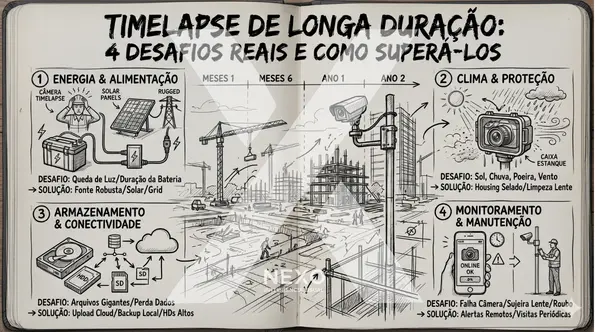
Long-duration timelapse is an entirely different category. When the goal is to document a project that will take several months or even several years, an industrial assembly unfolding over a year, or a terminal expansion spanning two years, the challenges multiply disproportionately to the additional time.
The core reason is simple: mistakes cannot be fixed. If the camera loses focus in the third month of an eighteen-month project, those three months of footage cannot be recovered. Construction does not reverse. The gap will remain empty forever in the final video.
Challenge 1: Adverse field conditions over consecutive months
A construction site is a hostile environment for any electronic equipment. Suspended dust, rain, extreme temperature swings, vibration from heavy machinery, mud spray, overnight condensation — the list of physical threats to an exposed camera is long.
Conventional cameras — DSLRs, action cameras, adapted smartphones — were not designed for sustained exposure to these conditions. They may work well in the first weeks and begin to show progressive failures from the second month onwards: a lens fogged by infiltrated moisture, a sensor with hot spots from overheating, buttons with contact failures from accumulated dust.
Beyond environmental protection, there is another critical problem: the camera must remain in exactly the same position for the entire duration of the project. Any displacement — even millimetric — shows up in the final video as an abrupt jump. On sites with constant vibration or where other workers may accidentally touch the equipment, maintaining a fixed position for months is a genuine logistical challenge.
The solution requires systems built specifically for this purpose: housings with IP67 protection or better, rigid mounting on a structure independent of the construction, and materials that withstand both high temperatures and extreme humidity without degradation.
Challenge 2: Technical failures with no possibility of a do-over
In short-duration projects, a technical problem is an inconvenience. In a long-term timelapse, it is potentially catastrophic. The most common types of failure — and the hardest to detect in time — include:
- Full memory card: the camera stops capturing silently, without alerting anyone. Weeks can be lost before someone notices.
- Card corruption: especially frequent in low-quality cards exposed to temperature swings, it can erase hundreds or thousands of accumulated images.
- Autofocus loss: vibrations, insects or temperature changes cause the camera to refocus on a different point, making the entire subsequent sequence unusable without an obvious transition.
- Power failure: a power outage without adequate protection can not only interrupt capture but corrupt the last file being written.
- Exposure parameter drift: direct sunlight hitting the sensor at certain times of day can trigger automatic compensations that make the image inconsistent over time.
"In a long-duration timelapse, active monitoring is not a differentiator — it is a necessity. The camera needs to be supervised with the same attention given to a critical production asset."
The key point is that all these problems are detectable — if there is an adequate monitoring system in place. Without one, the team discovers the failure at the next physical inspection, which may be weeks after the problem occurred.
Challenge 3: Storage and backup of massive data volumes
A high-resolution timelapse project capturing images every 5 minutes over a year generates a data volume that surprises those unfamiliar with the math. A camera capturing one image every 5 minutes produces approximately 288 photos per day. Over 365 days, that is more than 105,000 images per camera.
Storing that volume locally on a memory card at the site creates serious risks: theft of the equipment along with all the images, physical card failure without a backup, or simply running out of available storage space. Storing only in the cloud without a local copy creates a dependency on connectivity — on sites with unstable internet, uploads can fail silently for days.
A proper solution requires redundancy on two levels: temporary local storage on the device itself, with automatic and continuous synchronization to at least two independent cloud destinations.
Challenge 4: Remote access and maintenance without constant site visits
Cameras installed for long-duration timelapse are often in hard-to-reach locations — 20 or 30 meters high on a steel structure, in a restricted area of the site, or on projects in cities different from the company's headquarters. Each in-person technical visit has cost, risk and impact on site production.
The problem is that some adjustments are inevitable. The camera may need a lens cleaning after a week of heavy rain. Exposure parameters may need adjustment as seasons change. A firmware update may be required. Without full remote access capability — not just image checking, but complete control of all camera parameters — each of these adjustments requires a technician on site.
Proper systems for long-term timelapse allow remote access to and modification of all relevant parameters: capture interval, exposure, focus, PTZ camera viewing angle, and reboot in the event of a freeze — all without any site visit.
What a complete long-duration timelapse system must have
Based on these four challenges, the minimum requirements for a timelapse project that will last more than 60 days are clear:
- Industrial-grade physical protection (IP67 or higher) against dust, water and temperature
- Rigid mounting independent of the construction structure
- Active camera monitoring at short intervals — ideally every 5 minutes
- Dual storage with redundancy across two distinct cloud servers
- Internal UPS for protection against power outages
- Full remote access and control, without any need for in-person technical visits
- Automatic verification of captured images with alerts in the event of anomalies
The NEXO platform was developed with this set of requirements as its foundation. Every camera installed on a construction site operates with industrial protection, continuously transmits images to two cloud servers, and is automatically monitored to ensure no failure goes undetected. The daily timelapse is generated automatically, available on the platform every morning — without any action from the site team.