What a construction photo report is and why it matters
A construction photo report is a visual and descriptive document that systematically records the progress and stages of a construction or assembly process. It is more than a photo album — it is a critical instrument for monitoring schedules, documenting each construction phase, identifying deviations and maintaining transparency among all stakeholders.
In practice, this report serves multiple simultaneous functions. For the client or investor, it is visible proof that money is being applied as agreed in the contract. For the site manager, it is the timeline that allows comparing actual progress against the plan. For the legal department, it is evidence in the event of disputes over deadlines, scope or quality.
Construction companies that present organized and regular photo reports build a relationship of trust with clients that is rarely shaken by occasional setbacks on site. Those that lack this record face constant questioning — and often cannot prove what they did and when they did it.
Why most photo reports fail in practice
The problem is not the intention — it is consistency. In theory, every site team knows they should document progress regularly. In practice, photographs are taken when someone remembers, when there is spare time, or when a client asks and the team has to scramble to capture something.
This creates photo reports with gaps: weeks with no record at all, entire phases documented with only one or two photos, images taken from different angles at each visit (making any temporal comparison impossible). When the contractor needs to present the full history — for an audit, a dissatisfied client, a contractual dispute — the archive is insufficient.
There is also the problem of technical quality. Photos taken by different people, with different equipment, under different lighting conditions, with no standardized framing — the result is a set of images that documents superficially without creating any coherent visual narrative.
"Inconsistency is not the only problem with manual photo reports. The biggest risk is unconscious selectivity: teams photograph what looks good and avoid documenting what is delayed or problematic — exactly the opposite of what an effective report should capture."
How timelapse transforms the photo report
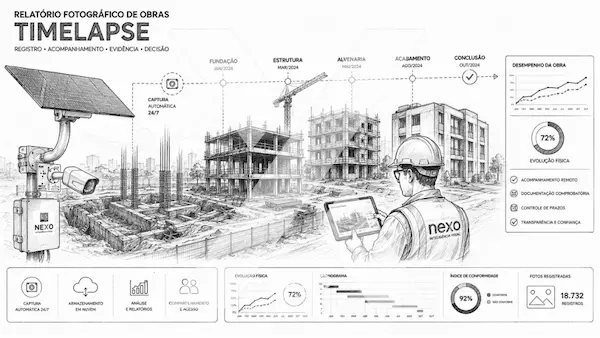
Timelapse elegantly solves all the structural problems of the manual photo report. Instead of depending on a person to remember to take photos and have the discipline to maintain standards, the timelapse camera records automatically — with the same framing, at the same interval, every day — regardless of the state of the construction, the weather, or who is on site.
The result is a truly complete photographic archive: every day documented, every phase captured, every event recorded. If there was a 12-day stoppage due to rain, it is in the record. If the structural steel team worked over the weekend to recover the delay, it is there too.
More importantly, timelapse captures moments that would never be intentionally photographed. The arrival of heavy equipment at 6 a.m. The moment the first slab was poured. The millimetric evolution of a structure over a week. No team would have the discipline — or the budget — to document this level of detail manually.
Structure of an effective photo report with timelapse
For the timelapse archive to function as a professional photo report, it needs organization. The raw images — hundreds of thousands over months — need to be accessible in a structured and shareable way. The elements of a good visual construction report include:
- Complete chronological archive: all images organized by date and time, with quick access to any specific period
- Automatically generated periodic timelapses: videos condensing the week, the month and the full history into easily shareable formats
- Visual comparisons: side-by-side views of different moments in the same framing, showing progress unambiguously
- Remote access for stakeholders: clients, investors and managers consulting the updated record without needing to visit the site
- Date and time metadata: each image with a precise timestamp, making the archive legally robust as evidence
Practical uses of automated visual reporting
With this level of documentation available automatically, applications multiply throughout the project:
- Progress meetings: instead of verbally describing what was done, the manager shows the two-week timelapse — no additional preparation needed
- Schedule updates: visually identify when a specific phase was completed, compared to the plan, without depending on manual records
- Training and onboarding: new team members watch the compressed construction history and understand months of work context in minutes
- Marketing and portfolio: the final timelapse video is the highest-impact content for proposals and social media, generated at no additional cost
- Defense in contractual disputes: timestamped visual evidence of every phase, impossible to contest
The NEXO platform automatically generates the daily timelapse from every camera installed on site — available every morning without any action from the site team. The complete historical archive is available on the platform, with tools to compare periods, export clips and share with clients or investors via a direct link.